


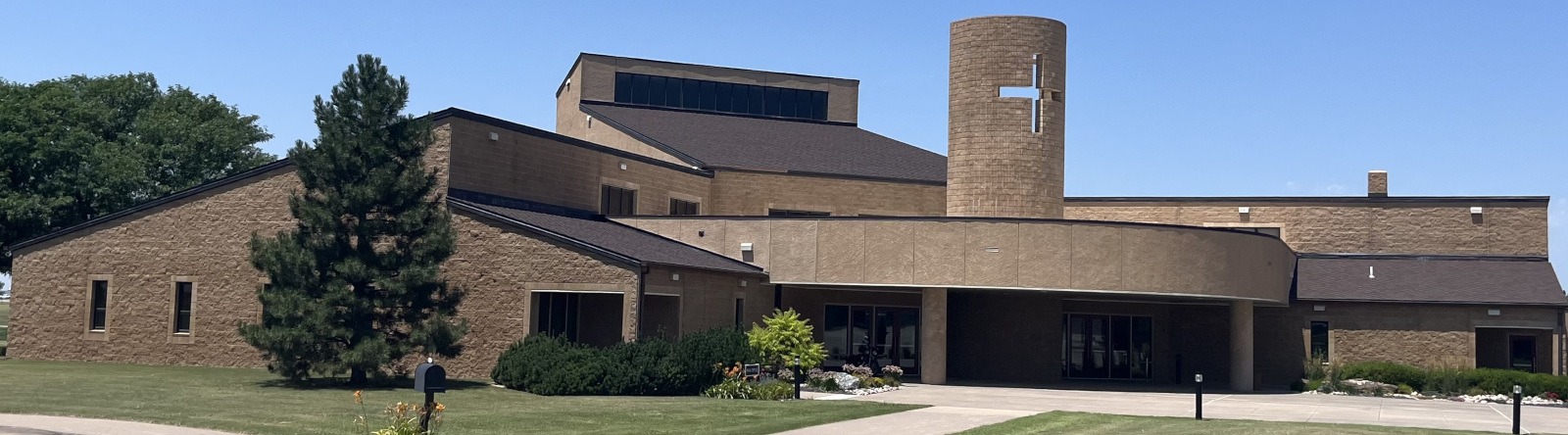
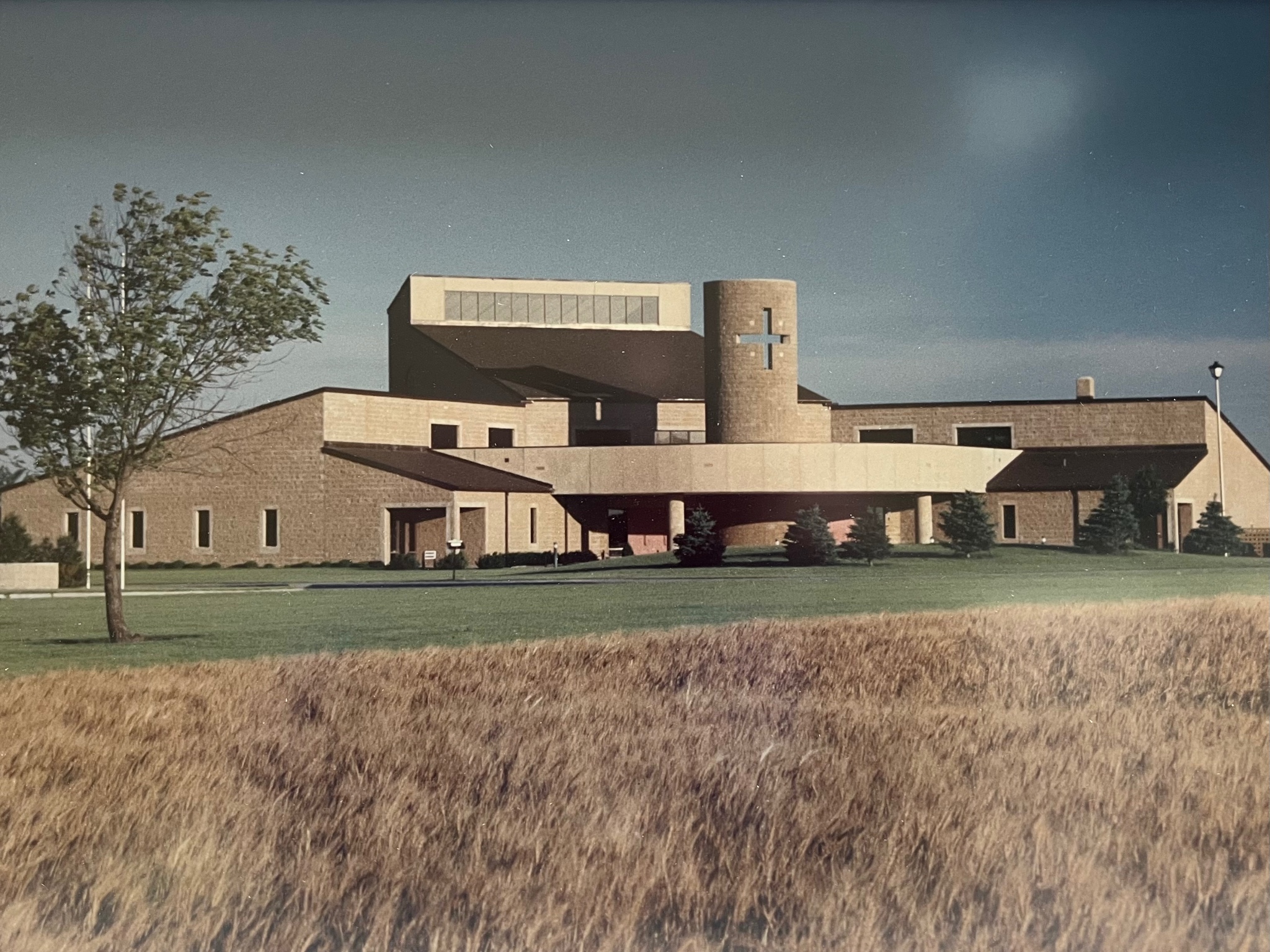
 The parish’s inception is attributed to the foresight and courage of Bishop Daniel Kucera, OSB (later appointed Archbishop of Dubuque, now retired). He wisely noted shortly after coming to the Diocese of Salina, that Immaculate Heart of Mary Parish had become too large for effective ministry and parish life. Consequently, the diocese purchased a tract of land (520 X 702) east of Hays from Nicholas Hoffman as a possible site for a new parish complex.
On the second Sunday of March 1983, the bishop confidentially shared his vision with Father Daniel Scheetz and asked if he would accept the challenge of starting a new parish. A formal letter of appointment as Founding Pastor was mailed on May 18. The canonical decree of erection of the new parish, with boundaries containing the homes of nearly 400 Catholic families, was published on May 23.
On June 8, 1983, a steering committee agreed to purchase a house at 1305 Agnes Drive, which served as rectory, offices and daily Mass Chapel for the next two and one half years. The first weekend liturgies were celebrated July 2-3 in Room 100 of Hays High School. Approximately 175 families formed the core of the “new church” in east Hays.
A building commission was formed on August 17, 1983. The Architectural Firm of Stecklein-Brungardt presented several alternative church designs to the entire church community on December 3, 1983. This was the first annual celebration of the Feast of St. Nicholas. On July 16, 1984, parish representatives again outlined the scope of the building project to diocesan officials. On August 6, Bishop George K. Fitzsimons granted permission to obtain bids for the new structure. In September 1984, Pierce-Schippers Construction of Hays was awarded a contract for $942,000.
On October 7, the Feast of the Holy Rosary, parish members (numbering 255 families) broke ground by drawing an antique plow across the building site. Soil brought from the home sites of parishioners was mixed in the furrow of newly broken ground as a symbol of “planting” new roots.
The sanctuary of the complex was 75% complete in July 1985 when the Finance Committee secured a buyer for the parish house, which led to the decision to complete the office wing of the church. This wing also was to be used for living quarters for the pastor. The contract was given to Paul-Wertenberger Construction Company of Hays.
The laying of the cornerstone took place within a prayer service on July 25, 1985. A “time capsule” containing documents, pictures, records and other memorabilia was sealed into the wall of the church tower at that time.
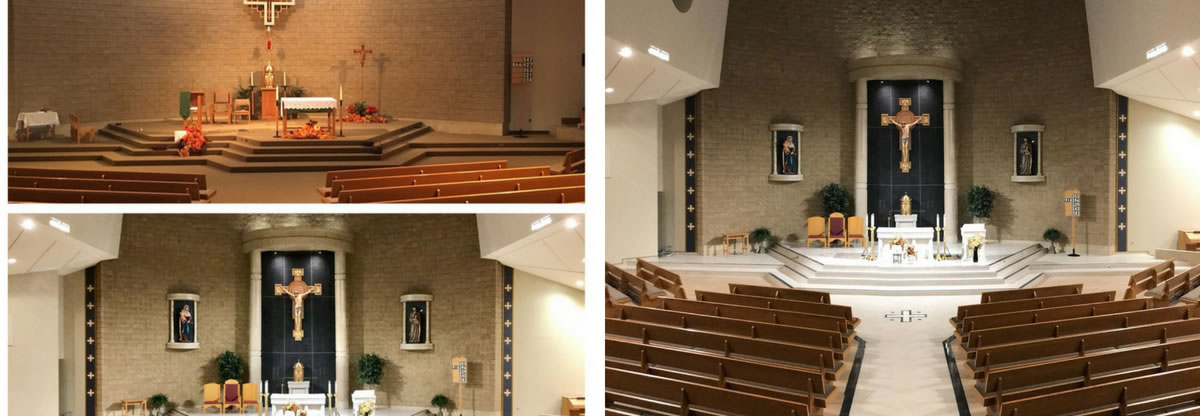
On September 1, 2018, Bishop Jerry Vincke celebrated a Mass at St. Nicholas of Myra commemorating the remodeling of the entire worship space. Included in that celebration was the consecration of the new limestone altar. Fr. Jarett Konrade led the renovation project which included a new altar and a matching ambo and tabernacle stand - all with limestone gathered from a quarry near Herington, KS. A new 10 foot tall crucifix, with the symbols of the four gospel writers at the tips of the cross, was flanked by large statues of the Blessed Virgin Mary and St. Joseph, along with a new statue of St. Nicholas.
New Stations of the Cross were hung, pews were cleaned and reupholstered. and light-colored tile in the sanctuary replaced carpet and lightened the space. Restrooms were renovated, a bride's room added and a new sound system was installed to enrich the liturgical music emanating from the new baby grand piano.
Today St. Nicholas is shepherded by Fr. Damian Richards and is noted for its strong lay involvement. Lectionary-based catechesis and meaningful liturgies enlivened by quality liturgical music are just two great sources of pride for the parish.
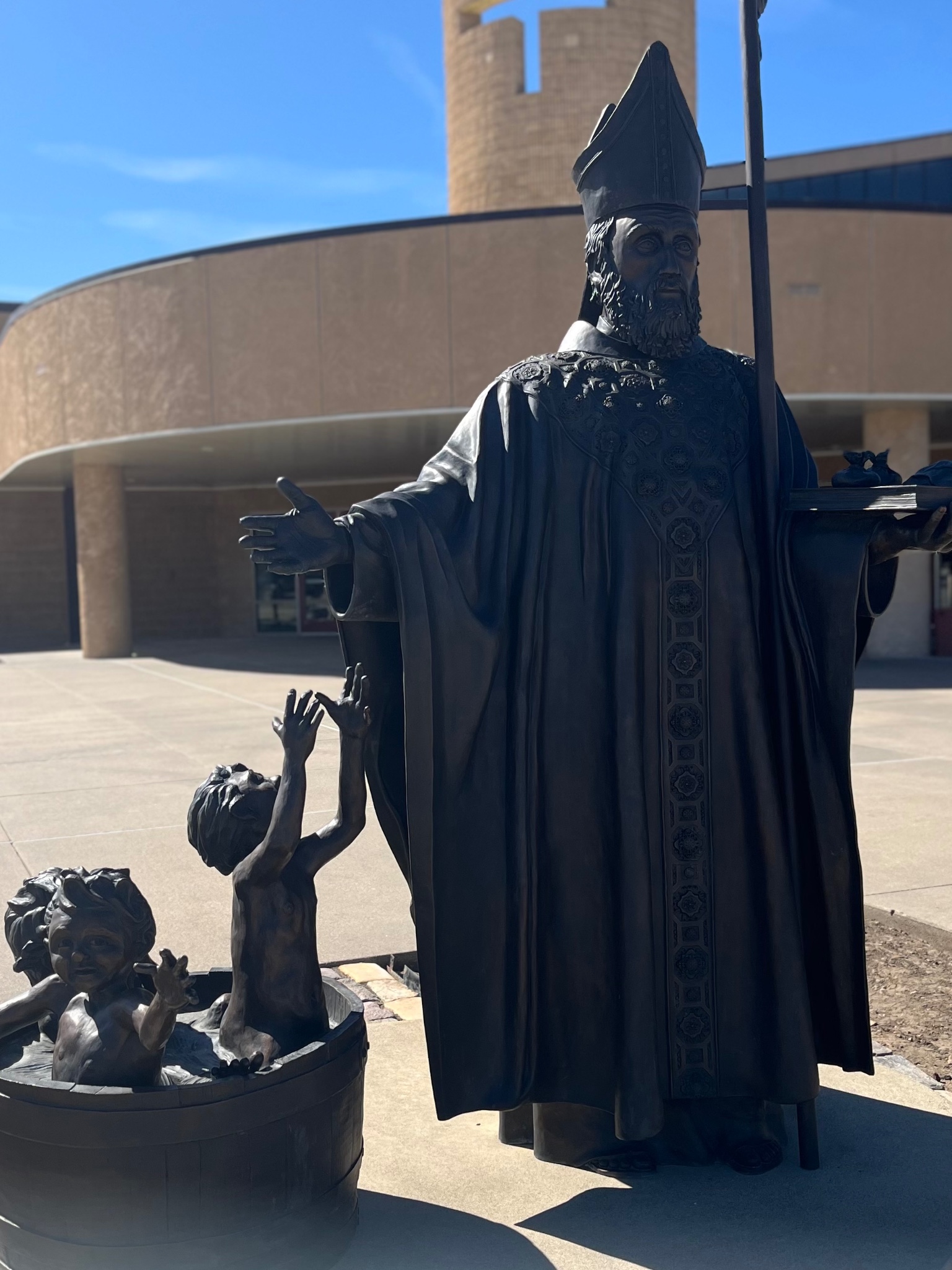
Have you ever noticed the statue in front of St. Nicholas of Myra Church? Have you wondered about the story behind it? Well, here you go! It is the story of Nicholas resurrecting the children. There is a wonderful pro-life message behind it! The story goes that, during a time of famine, three small children were gleaning in the fields. As they worked and played, they wondered off into the town. Walking about and exploring, the children forgot the time. When it was late and the sun was going down, the children were hungry, tired and lost. They came to a lighted butcher’s shop, knocked and said, “We are lost and hungry. May we eat and sleep?” “Oh yes,” came the reply, “Do come in.”
As they enter, the butcher takes a sharp knife, cuts them up, and put them in a large salting tub. His plan was to grind them into sausages and pretend they were pork. Bishop Nicholas, however, had his suspicions. He was a good judge of character, and could tell when something was off. So, hearing about the missing boys, Nicholas appeared at the butcher’s door, saying to the evil butcher “Open your large salting tub!” The saint put his hands on the tub and, appealing to God, say, “Rise up children!” The little children awake and stand up. Their families joyfully welcome them home.
This is what is going on in our statue in front of church. Ever since then, Saint Nicholas has been the patron and protector of children. There are other versions of the story which change the details of how the boys were killed, and how the butcher was planning on eating them—but the core is the same children suffer an awful fate, only to be rescued by Nicholas.